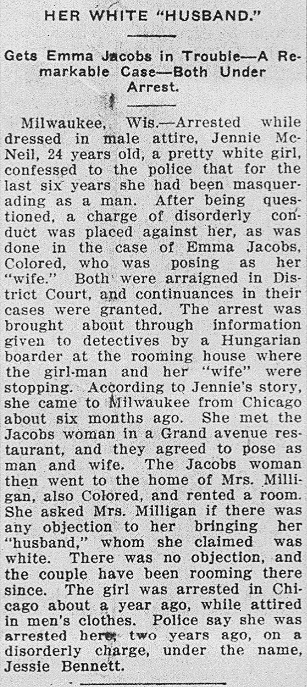
While researching the reception of DW Griffith’s The Birth of a Nation (1915) in Cleveland, Ohio for a class taught by Dr. Dan Morgan, I came across an article in the Cleveland Gazette (Cleveland’s premiere Black newspaper) which inspired me to radically reorient my understanding of early 20th century women’s history, especially in relation to film and print media. It was published on July 24, 1915.
That trans people existed before cissexuals “discovered“ them is an undisputed fact — the mere fact that a trans man lived in Cleveland, Chicago and Milwaukee in the 1910s (and was persecuted by the state) should surprise no one. What captivates me most about this article is the fact that it was news — and exciting, salacious, arguably erotic news at that. Black Clevelanders were expected to be interested in the fact that a Black woman in Chicago dated a white trans man; the people who wrote this article understood outing this trans man to Clevelanders as a necessity simply because he lived there two years ago. Certain awkward phrases concerning race, sex, and hetero marriage call for attention. Why must we know Jessie was “pretty“? Why must we know the boardinghouse was run by a Black woman, or that a Hungarian turned the offending couple in? It is as if the author feels the need to assert he is capable of speaking about Blackness, nationality, and sex as a matter of fact. The most interesting was the phrase, “her ‘husband‘, whom she claimed was white”. This is quite a bizarre way of putting it, as the man in question, the Gazette unambiguously states in the first line, is white.
Emma Jacobs “lied” about having a white husband, but that is not simply a “lie” about the sex of her partner. It is a lie about her own racial, marital, and sexual status. The paranoia of the article is not restricted to a fear of hidden transsexuals. It speaks to a fear of transsexuality as a uniquely apocalyptic form of perversion capable of subverting modernity’s racial, sexual, and moral functions.
It speaks to a fear that all women would choose to be men if given the chance.
I want to undertake a documentary project at some point in the coming years wherein I retrace Jessie Bennet’s steps from Cleveland to Chicago to Milwaukee, and search for more evidence of his life and persecution in print.